Microsoft Sure Can Innovate! ...Or Maybe Not?
1 comments Posted by Sarah, Dave, Grace & Ellie at 9:55 AM
In a recent article (full text found at http://blogs.zdnet.com/storage/?p=370) Ron Harris, of ZDNet.com, writes about Microsoft, referencing a very honest interview done recently by Microsoft's Chief Software Architect, Ray Ozzie (for those who are wondering, a guy named Bill Gates used to hold the same title).
In the article, Mr. Ozzie is actually quite critical of Microsoft, stating that their path to innovation in the past has been to demonize their competitors and define themselves in opposition to said competitors. By simply drawing a line in the sand, Harris argues that Microsoft fails to think about what they're doing. His argument: Microsoft is not, in fact, a particularly great innovator. Instead, they've bought products over the years and tweaked them. I'd agree that this is less innovation than understanding where to put your money. And is that such a bad thing?
What Microsoft does well is what they need to leverage moving forward. Mr. Harris seems to agree, stating that what Microsoft needs isn't revolution, but profitable evolution.
Ultimately, it's an interesting take on a company that many people - especially those with only a skin deep understanding of the industry - will cite as a truly innovative firm. I tend to agree with the assessment, and it sounds like some of Microsoft's recent misses have finally gotten them to take notice as well.
I'm a late adopter for most technology and therefore, I do not have an iPhone or Blackberry. I am thinking about getting the G1 phone but I'm worried if I have access to the internet 24/7 I might get really addicted to it and every time I get an email I will be looking at my phone. I can also imagine my blood pressure will rise. Anyway, I hear there are these things called "apps" for iPhone. Here is a new one called Real Tree. See the original article for more info:
http://www.goodcleantech.com/2008/12/iphone_app_plants_a_real_tree.php
Basically you purchase a "tree" for 99 cents and then you get a tree on your iPhone. The money goes towards education people about reforestation efforts across the globe. The tree on your phone can grow flowers or even have the wind go threw it.
I personally do not find any use for this but maybe others will like this relatively lazy and cheap way of being involved with the environment? We will have to see how it does.
In the December 3, 2008 issue of Businessweek.com, there is an article about packaging innovation from McDonald's. The article explains that McDonald's is attempting to create personalities for each of their products, and provide consumers with visual cues that remind them that McDonald's products are made from "real food." The full article can be seen here:
http://www.businessweek.com/innovate/
While I applaud McDonald's for striving to find solutions to make their packaging more environmentally-friendly, it seems as though this re-design is just change for the sake of change. In addition to rolling-out the new packaging to update the McDonald's brand and product line, "McDonald's is also trying to stay ahead of concerns over obesity" (Businessweek.com, 12/03/08). The McDonald's team believes this concept will satiate a global appetite for greater information about food products, though I'm not convinced this is a need-based driven innovation. Certainly, as US consumers are faced with a difficult economic environment, McDonald's might have been better off spending time on innovation in the area of promotions instead of refreshing the look and packaging of their products. Or, perhaps McDonald's could allocate some of its resources to addressing the nutritional composition of its products.
 At a time when the executives from the Big Three are flying to Washington, DC to grovel for tens of billions of dollars to keep their floundering businesses afloat, a small auto manufacturer in Northern California is doing things a bit differently. Tesla Motors, the nation's leading all-electric car company, manufactures zero-emission luxury sedans in the heart of Silicon Valley.


So you're probably wondering.... How does it work? Although conventional cars have over 100 moving parts, the Roadster has just one: the rotor. The Roadster's elegantly designed powertrain consists of just four main components: battery, motor, transmission, and power
 electronics module.
 According to Tesla Product Achitect and Chairman Elon Musk, "Tesla has amazing momentum right now. The excitement within the company is palpable. The company has clearly taken production of all-electric vehicles to the next level, and the Model S assembly plant will dramatically accelerate our growth."
Beware of Alliances: The Dark Side of Collaborating with Competition
1 comments Posted by John T Ribolzi at 2:08 PM
Let's turn back the clock to Summer, 2004, Kansas City MO/KS. Voters were determining whether or not to levy an arena tax on the rental car and hotel industries to finance the proposed Sprint Center, an arena designed to revitalize the downtown area and potentially entice a professional basketball or hockey team to relocate to Kansas City. Standing in opposition to this arena tax was the newly-formed Coalition Against Arena Taxes. Points for creativity on the name.
The Coalition Against Arena Taxes consisted of around 30 members from different local businesses including one rental car agency that we will refer to as Every-prize Rent a Car (as well as a few other rental agencies). Every-prize's argument against the arena tax centered on their concern regarding the disproportionate increase in expenses - in some cases up to a 40% - on their local renter. Their goal was to have the arena tax limited to airport location and to be decreased from a $4/day tax to a $2/day tax of which Every-prize shared common ground with their competitors. Other CAAT members voiced their concern over the potential for a trickle down tax on their businesses should the financing partners either pull out of the non-binding agreement or should total funding be insufficient.
While an alliance was created between Every-prize and a few of its rental car competitors aligning their mutual concern over such a significant tax imposition, when the debate grew more heated in the last few weeks, it was Every-prise alone that received the negative backlash from the powers that be in Kansas City. The news media spun the Coalition's objections as an attempt from Every-prize, a St Louis based company, to stifle the attempts of Kansas City to gain a professional sporting team in the hopes that such a team would prefer St Louis. While an absurd claim, it succeeded by reinforcing the Napoleonic complex and biases of the Kansas City citizens against St Louis. Apparently winning the 1985 World Series over the Cardinals was insufficient.
While Every-prize was tacking a lashing in the news and through boycotts and picketing, their "allies" determined that the best way to handle the situation was to avoid the spotlight and let Every-prize take the heat. We have discussed the benefit of alliances in a few courses now, including NPD, and I thought it important to mention that whether vertical or horizontal alliances are created between two competing companies over a mutual desire to launch a new product or to protect themselves from an industry-wide occurrence, beware of those with whom you ally.
Recently, I learned about Playing For Change:Peace Through Music. PBS presented a documentary about this new innovation led by Mark Johnson on the Bill Moyers Journal. The innovative product is music that has been co-created by musicians across the globe. The driving force of the film is to find a way to inspire the planet to come together as a human race through the universal language of music. Johnson and his team want to focus on our connections rather than all of our differences. They believe music can break down the walls and barriers between cultures, and raise the level of human understanding and connection.
The project took three years to complete. As the team traveled around the world, the idea was to get as many different cultures and races to sing songs together to inspire the world to come together through music. Roger Ridley, a street musician in Santa Monica, CA, caught the attention of Mark Johnson. Ridley's voice intrigued Johnson to the point that he asked him for permission to come back with recording equipment to video tape and record him as he sang "Stand By Me." Ridley agreed.
The co-creation happened as each musician added to the song "Stand By Me" without meeting any of the other musicians. First, Johnson recorded Roger. Next, he went to a Native American Zuni reservation, put headphones on the natives, let them listen to Roger sing and play the guitar, and then they sang and played the drums over Roger's recording. Afterwards, he went to South Africa and put headphones on a Zulu choir situated on a mountain top, they listened to the new version of "Stand By Me," and they played on top of it. This continued across the globe. Johnson's final product ended up featuring approximately thirty-seven musicians who never met, all playing "Stand By Me" together, live, outside, and around the world. He and his team use the music to inspire the planet, and have created a foundation to build music schools in some of the communties of the participating musicians. Visit www.playingforchange.com/pop.html for more information and to watch the video. Once on the website, click "enter," then "click to play
 of the Nike Zoom LeBron VI shoe.
In an age when video games are differentiated by specifics such as HD graphic resolution, Sony sought to take a step backwards and develop a product with broad enough appeal to attract as many consumers as possible. This challenge, however, did not rely on piecing together the ultimate gamer market segmentation report. Rather, Sony needed to create an approach that did this groundwork for them, fast. The Wii gamer segment, where users are personalizing their machines and game profiles to interact with an online community, is growing steadily and, most recently, out-sold Sony's PS3 over 4 to 1 (http://www.1up.com/do/newsStory?cId=3171305). Further, video game production costs, 3 years ago, ranged between $3 million and $6 million (http://news.bbc.co.uk/1/hi/technology/4442346.stm). Estimates today place costs upwards of $20 million. New video games, thus, need relatively strong ROI.
So, t hen, how might Sony safely reach as many customers as possible? Meet LittleBigPlanet. LBP is a world where gamers guide 'Sack puppets' through any challenges made available to them. These 'Sack people' range from being entirely new to resembling characters from various other popular games. And, of course, they can be customized.
 But Sony did not stop at this simple functionality, which is found in a majority of today's games. LBP is a semi-open game platform in the form of a developer's kit. Players can build their own worlds quickly, customized however they please. These worlds can then be shared online amongst the PS3 LBP community. Appropriately, LittleBigWorkshop's catch phrase is Play. Create. Share.
While there were 50 pre-built levels included with the game, Sony looks to the community of LBP gamers to create worlds of play applicable to their demographic or something to which their segment is emotionally tied. For example, there is an up-cropping of worlds resembling the early Mario Brothers games. This 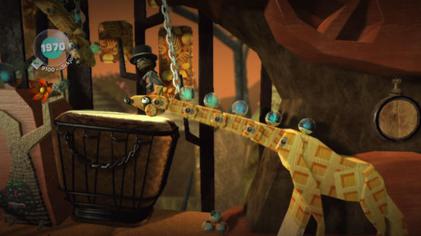 externalization of NPD (albeit partial because gamers do not truly create an entirely new product) is apparently a fun process for the user and results in a products personalized to a broad spectrum of segments. This is not the first game to provide this capability; level building dates back to at least 1991 in a game by Epic called ZZT (http://blog.wired.com/games/2008/10/first-impressio.html). However, this does represent a shift towards NPD via social media, where gamers add value to their own community through co-creation. The result thus far, though muddled by the current recession, is reasonably good. After its launch completed early this November, LBP's sales placed it in the top 10 titles for October with only a few day's worth of availabilty accounting for that ranking (http://www.1up.com/do/newsStory?cId=3171305).
Another interesting and, perhaps, more poignant insight is that this same approach and capability, including all the community communication elements, were available for PC games decades ago. Sony's LBP model is hardly a new concept for innovation. Yet, perhaps users were not yet conditioned to develop and share as readily as they are today.


Another Example of Co-Creation
I thought I would give you all a sneak peek at my latest innovation. Ellery Lynne Lincoln is now 33 weeks and still in the research and development phase. We have an expected launch date of 1/22/09. In this particular case we are not only the innovators but also the consumer, so to speak. Although, with those cheeks, it might be debated who is doing the consuming!
“Innovation is something truly different in the market that makes your customers’ lives better.”—Herb Baum, CEO Dial
We anticipate that this innovation will follow some of the basic innovation guidelines:
- Something new and valuable
- Alter the way we live
- Deliver benefits/solve problems
This innovation is important because our "firm" has a focus on innovation as a means for growth.
On the Product-Market Matrix she would be a market development: existing product (baby) for a new market (Daniel and me).
Daniel Lincoln and I have formed a NPD Alliance to produce Elle. “A formalized collaborative arrangement among two or more organizations to jointly acquire and utilize information and know-how related to the R&D of new product innovations.” (Aric Rindfleisch lecture slides)
Although we are aware that most new products fail, we are hoping to mitigate this statistic by addressing the following criteria:
•Most failures seem to be due to poor sensing rather than bad solutions.
We feel we have the pulse of the consumer and are sensing the right time for launch
•Other key problems include risk aversion and slow development times.
Through thorough research we have determined that the levels of risk aversion are at an all-time low and we are positioned to offer a product that falls well within the risk criteria of the target segment. Although the development time appears to be on pace with industry average (40 weeks), the risks associated with expedited development do not appear to offset any rewards.
However, we are also aware that failures may not always be bad. We are focussed on learning from our mistakes and using them to continue to innovate with Elle.

